





The Perfect School Backpack: Tips for Choosing Design, Ergonomics and Size
For many children, their first school backpack is a real highlight – and for parents, an important decision. Alongside colourful designs and cool motifs, what matters most is that the backpack is comfortable, practical and healthy for a young back. But how do you find the perfect school backpack? Let's answer the most important questions!
When Should You Buy a School Backpack?
Most parents start their search for the right school backpack in spring, before the start of school – at this point, the first day of school is still around six months away. Parents therefore have plenty of time to compare different models and prices. Spring also offers the widest selection of school backpacks, and many shops entice buyers with discounts.
If the start of school is still six months away, your child's height may still change before then. That's why it's worth choosing a school backpack that grows with your child, such as school backpacks with an adjustable, height-adaptable harness system.
Some parents wait for deals shortly before the school year begins. This is often cheaper, and you can fit the backpack to your child's current height. However, the selection may already be limited by then.
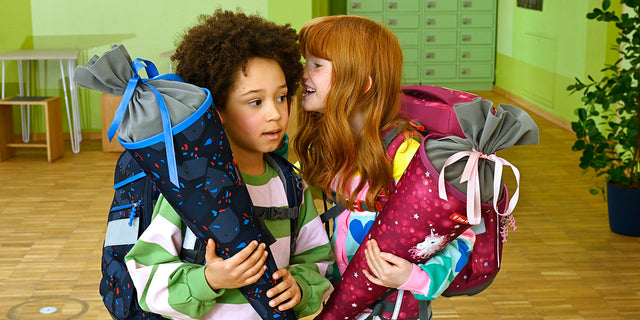
Still looking for a school backpack for your child's first day of school? Discover current models for first-graders from brands such as ergobag, Step by Step, Scout, DerDieDas & Co.
-> School backpacks for Year 1
School Backpacks – What Should You Look Out For?
When choosing the right school backpack, parents should consider these 6 criteria:
Ergonomics
Ergonomic school backpacks focus on being back-friendly. To avoid straining the spine, the backpack should have padded shoulder straps, a reinforced back panel and ideally a chest or hip strap. With these practical straps, your child can carry the daily weight of school books with minimal strain on their health.
Visibility
Reflective elements on school backpacks are a must, so your child is clearly visible in traffic, even in poor weather or in the dark.
Size
Many children go through significant growth spurts during primary school – yet the backpack should fit perfectly from Year 1 to Year 4. Make sure the ergonomic school bag has a continuously adjustable back system and an adjustable chest strap. This way, the backpack can be adapted to your child's back after every growth spurt.
Storage Space
Look for clever compartments and pockets so your child can stay organised. Ideally, the compartment closest to the back should be larger, so heavy books can be stored there. The closer heavy items are to the back, the easier they are to carry. An external side pocket for drinks can help prevent a hastily closed water bottle from damaging the inside of the backpack if it leaks.
Build Quality
A school backpack has to withstand a lot – after all, it's used five days a week. Durable and water-resistant materials protect notebooks and books from rain and snow. Magnetic fastenings make it quick and easy for your child to open the backpack – even with just one hand!
Design
Ultimately, your child should love their school backpack too. Let them have a say in the decision, since they'll be the one wearing it every day. Whether it's dinosaurs, princesses or cool colour gradients – design matters just as much to children as wearing comfort. Velcro patches in various designs can be attached to many models as desired – so your child can swap their favourite motifs onto the backpack whenever they like.
How Heavy Should a School Backpack Be?
The weight of the school backpack is one of the most important factors. Ideally, the backpack shouldn't weigh more than 10–15% of your child's body weight – including its contents. For example, if your child weighs 20 kg, the backpack should weigh no more than 3 kg. So when buying, don't just consider the backpack's own weight, but also think about how heavy the school supplies might get in everyday use.
A quick tip: Check the backpack regularly. Toys or unnecessary notebooks often sneak their way in, adding extra weight.
How Many Litres of Volume Should a School Backpack Have?
The volume of the school backpack mainly depends on the age and the number of school materials needed:
- For primary school (ages 6 to 10), models between 15 and 20 litres are sufficient.
- In secondary school, more books, larger notebooks and additional materials are often needed, so the backpack should have a volume between 20 and 30 litres.
-
In sixth form/further education, a backpack of up to 35 litres can be useful.
Buying a School Backpack: Our Top Brands
With so many great brands out there, are you unsure which one best suits your child? Here's an overview of the advantages and special features of our top brands:
ergobag
Ergobag combines ergonomic innovation with recycled materials:
✓ Ergonomic school backpacks inspired by trekking backpacks
✓ Materials often made from recycled PET bottles
✓ Long lifespan thanks to a growing harness system for the perfect fit
✓ Interchangeable Velcro patches for individual styling
-> Discover ergobag school backpacks now
Step by Step
Step by Step offers maximum safety and design variety for the perfect school kit:
✓ Focus on safety and visibility in traffic thanks to reflective elements and bright colours
✓ Wide range of designs for different tastes, plus customisation with interchangeable motifs
✓ Expandable sets, often including accessories such as pencil cases and PE bags
✓ Complete solutions with all the accessories included
-> Browse Step by Step backpacks
DerDieDas
DerDieDas sets new standards for comfort and ergonomics with ultra-lightweight school backpacks:
✓ Extremely lightweight backpacks, ideal for smaller or petite children
✓ Ergonomic back padding and adjustable straps
✓ Thoughtfully structured interior layout
Coocazoo
Coocazoo stands for stylish, ergonomic school backpacks with an individual touch and a focus on safety:
✓ Ergonomic school backpacks for older children and teenagers
✓ Wide variety of designs, extensive colour range and personalisation options, often with reflective details
✓ Plenty of storage space for books and leisure items
-> View Coocazoo school backpacks
Scout
Scout is known for safety, durability and child-friendly designs:
✓ A classic among school backpack brands with decades of experience
✓ Safety thanks to generous reflectors and bright signal colours
✓ Wide range of designs with child-friendly motifs
✓ Proven quality and durability
In summary: Take enough time to choose the ideal school backpack. The backpack should always be ergonomic and fit well – this way, the load on the back doesn't become a strain on your child's health. With these tips, you're sure to find the perfect school backpack – one that not only protects a young back but also makes every school day just a little bit brighter.